Bookshelf: The Comfort Crisis by Michael Easter

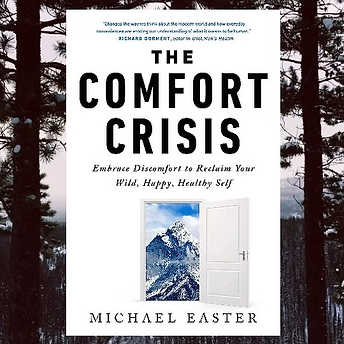
The premise of Easter's book is that modern life is incredibly comfortable, possibly to a fault. Since the industrial revolution and especially in the past century, massive effort has gone into removing discomfort from our daily lives. Innovations like air conditioning, industrial food production, are all taken for granted, but for most of human history struggle and discomfort haven been central to the human condition.
Easter argues that by eliminating everyday discomfort, we may also be eliminating opportunities for personal growth, resilience, and even better mental/emotional/and physical health. Kids these days...
The author describes his one struggle with discomfort and his personal quest to introduce hardship into his own life for personal development. He details a month-long hunting expedition in the Alaskan wilderness and blends his own personal observations with science, evolutionary biology, psychology and exercise physiology. All personal interests of mine.
Concepts I Enjoyed
Comfort Is a Double-Edged Sword
Modern convenience has replaced timeless hardship. We've lost opportunities for physical activity, challenge, and exposure to nature. It brings me back to SAID (specific adaptation to imposed demand). The human body adapts to the demands of its environment. It's not about discomfort for the sake of discomfort. He's not suggesting putting rocks in your shoes. It's more about imposing demands on yourself to not only explore your limits, but also to expand those limits.
The Misogi: Do Something Really Hard
One of the book's coolest concepts is misogi: undertaking an extraordinarily difficult personal challenge, something with a real possibility of failure (but only a limited possibility of death or major injury) The point isn't competition or achievement. It's discovering what you're capable of.
When I was a kid I went on a 2-week outward bound excursion. Unlike most of my fellow participants, I did it for fun rather than as some sort of punishment. I was a lot less introspective at age 14 than I am now, but looking back I impress myself by what I achieved. With a 50 lb pack, I covered 10-18 miles per day drinking nothing but creek water sterilized with iodine.
While reading this book I actually started looking for similar opportunities for adults, but that would be a different sort of challenge now that I have kids and a business.
Rediscover Boredom and Nature
Easter explores the value of spending time outdoors and occasionally disconnecting from constant stimulation. This is an idea that I more or less immediately implemented, more for my kids than for myself. When I walk the dogs or do yardwork, I leave the earbuds in the house. I let my kids run rampant in the backyard and invent their own sort of fun.
As far as my kids are concerned, putting them outside is like a parenting cheat code. My wife and I are considering making "bored" a bad word in our house.
What We Liked—and Where We'd Pump the Brakes
What I liked: The central message aligns with what we know about physical adaptation. Our bodies need appropriate challenges to maintain and develop strength, endurance, and physical capacity. I think it's an especially valuable message when it comes to my own children.
Criticisms: Not every proposed benefit of cold exposure, fasting, or extreme discomfort is supported by equally strong evidence. Importantly, discomfort itself isn't inherently beneficial. The dose, context, and individual's health matter.
I listened to the audiobook version of the book and I have another minor complaint. Sometimes the author isn't the best person to perform the recorded version. This is one of those times.
Worth The Read?
Yes. While reading I was constantly reminded of Daniel Lieberman's book The Story of the Human Body: Evolution, Health, and Disease and the concept of evolutionary mismatch diseases. The human spine is evolved (or designed) for walking long distances and carrying heavy loads. In my opinion, the introduction of the chair to the human spine and the reduction of "normal stresses" has something to do with the 31 million Americans currently experiencing lower back pain.
You can and should cherry pick some of the advice from the book. The Misogi is an exciting concept, but I would have real trouble going on a month long elk hunt with putting unnecessary hardship on my wife and kids. Although, maybe they would grow from the experience?
It's also important to remember that "challenge" is relative. For some people, walking a mile is challenging. That's a huge opportunity.
The Comfort Crisis is a reminder that the goal of a healthy life isn't to avoid every challenge. Sometimes the things that make us uncomfortable are the very things that help us grow.
Dr. Garapola

Comments